Line Repaints Between Resurfacings
Courts are resurfaced every several years, but lines fade sooner. A repaint on the existing layout brings the court back for the season.
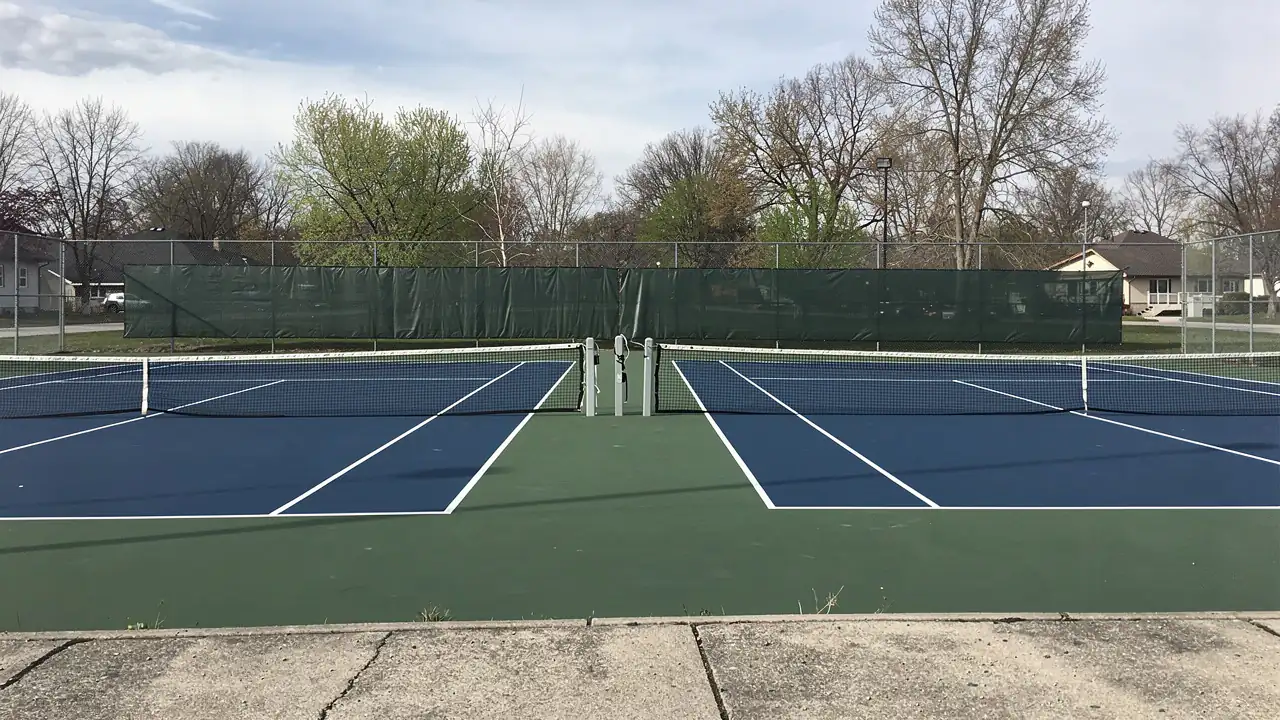
Clubs, parks and school courts
Kitchener Parking Lot Line Painting Pros lays out and repaints tennis court lines for private clubs, municipal parks, schools and condo amenity courts across Kitchener-Waterloo. Every court is measured to the ITF Rules of Tennis, the same dimensions Tennis Canada uses, so a service box in Waterloo plays like one anywhere else.
Tennis is an unforgiving sport to paint. The doubles court is 23.77 m by 10.97 m, most lines are only 2.5 to 5 cm wide, and a competitive player will notice a service line that sits 5 cm short.
We have painted lines in Waterloo Region since 2015, and our tennis work is planned around the May opening most clubs aim for. Our line paint is 100% acrylic from the same family as your court surfacing, so it flexes and wears with the court instead of flaking off it.
What we paint
Our tennis work falls into four jobs, from a straight line refresh to laying out a full club facility. Lines are the only thing we paint; the court surface itself belongs to a resurfacing contractor.
Courts are resurfaced every several years, but lines fade sooner. A repaint on the existing layout brings the court back for the season.
A new colour coat hides the old lines completely. We relocate the net posts, rebuild the layout from scratch and paint it to ITF dimensions.
Two pickleball courts added in a contrasting colour, with tennis left fully playable. Our pickleball court line painting page covers the layouts.
Banks of three to eight courts painted in one visit, with every court checked against its neighbours so the lines run parallel down the row.
Warning signs
Tennis lines need repainting when players can no longer judge a ball on the line, usually after two to three Ontario winters on a busy court. Four signs tell you it is time.
The baseline takes the most foot traffic, so it goes chalky first. Rub it with a fingertip; white powder means the binder in the paint has broken down.
Freeze-thaw cycles open cracks in the asphalt under the acrylic, and paint along a crack lifts with it. That needs crack repair before new lines.
Faint outlines from a previous layout or a removed court confuse players. They need to be covered by resurfacing, not by more line paint.
When members argue about balls on the line, the edges have gone soft. A crisp, taped line ends most of those arguments.
ITF dimensions
A regulation tennis court is 23.77 m long and 10.97 m wide for doubles, with an 8.23 m singles court inside it. These are the figures from the ITF Rules of Tennis, which Tennis Canada follows.
| Element | Metric | Imperial |
|---|---|---|
| Doubles court | 23.77 m x 10.97 m | 78 ft x 36 ft |
| Singles court width | 8.23 m | 27 ft |
| Service line from the net | 6.40 m | 21 ft |
| Service line to baseline | 5.485 m | 18 ft |
| Each service box | 6.40 m x 4.115 m | 21 ft x 13 ft 6 in |
| Baseline width | Up to 10 cm | Up to 4 in |
| Other lines | 2.5 to 5 cm | 1 to 2 in |
| Centre service line | 5 cm | 2 in |
| Centre mark on each baseline | 10 cm long, 5 cm wide | 4 in long, 2 in wide |
| Net height | 0.914 m at centre, 1.07 m at the posts | 3 ft at centre, 3 ft 6 in at the posts |
| Net posts | 0.914 m outside each doubles sideline | 3 ft outside each doubles sideline |
| Recommended run-off | 6.40 m behind each baseline, 3.66 m beside each sideline | 21 ft and 12 ft, for a 120 ft x 60 ft enclosure |
All measurements run to the outside edge of the lines, so a ball touching any part of the line is in. The centre service line is the exception: it is centred on its measurement, splitting the service boxes evenly.
The ITF also requires every line to be the same colour. That is why any extra lines for other sports go on in a different colour, never white.
Blended lines
Pickleball lines can share a tennis court without bothering tennis players if they are thinner, in a softer contrasting colour and kept clear of the baseline and service line. Tennis lines stay white and dominant.
Layouts, colour choices and pickleball dimensions are covered in depth on our pickleball court line painting page, and every option for shared courts is on our sports court line painting overview.
Our process
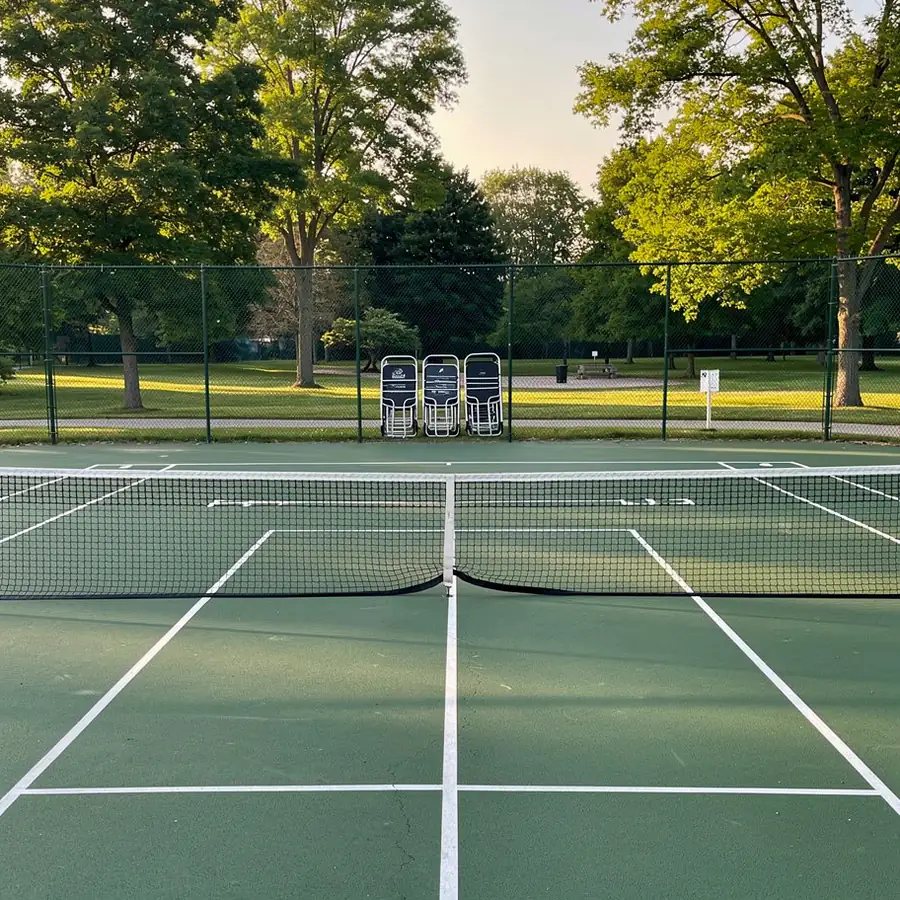
We paint tennis lines in six steps, and a single court usually takes one full day from layout to tape removal. Most of that day is measuring and taping.
The net line is the reference for everything. We find the post sleeves, set the net line between them and mark the centre of the court.
We measure out to the baselines and sidelines, then check both diagonals. On a true doubles court each diagonal is 26.18 m (85 ft 11 in), and if they differ the court is out of square.
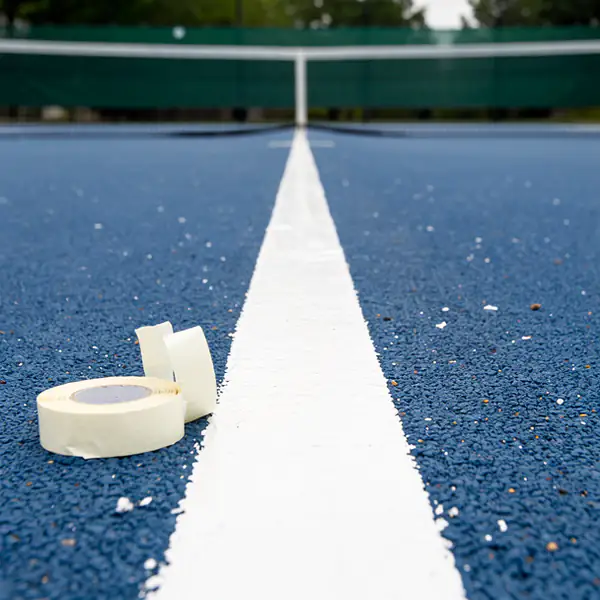
Chalk lines mark each edge, then tape goes down on both sides at the exact width: 10 cm for baselines, 5 cm for the rest.
A thin coat of line primer or the court colour seals the tape against the textured surface. This stops line paint bleeding under the tape.
We roll on 100% acrylic textured line paint matched to the surfacing system, such as Laykold or Plexipave. Its sand texture keeps the line from playing slicker than the court.
Tape comes off while the paint is wet. We check line widths and the centre mark, then email before and after photos the same day.
Pricing
Tennis lines on an acrylic surface cost $900 to $1,600 per court before HST. Clubs painting several courts in one visit usually land toward the lower end per court.
| Job | Typical price before HST |
|---|---|
| Line repaint on one acrylic court | $900 to $1,600 |
| Blended pickleball lines added to a tennis court | $350 to $650 per pickleball court |
| Touch-ups and small repairs | $450 minimum charge |
See our line painting price guide for every other rate.
FAQ
Club managers and parks staff ask these questions most often before booking tennis line work.
Tennis lines are painted with 100% acrylic textured line paint that matches the court's surfacing system. Traffic paint is the wrong product; it is too hard and too slick for a playing surface.
We can, but lines over open cracks will lift as the cracks move through winter. For lines that last, have the cracks filled by a court surfacing contractor first.
On a busy club court, lines usually stay sharp for two to three seasons; a lightly used condo court can go longer. Ontario freeze-thaw winters are hard on any outdoor court, so check the baselines each spring.
Yes. We add pickleball lines in a contrasting colour around the existing tennis layout, and tennis stays fully playable.
Free quote
Clubs that want fresh lines for a May opening should book in March or early April, before our spring calendar fills. Send the number of courts, surface condition and a few photos, and we will quote within one business day.