First-of-Season Layouts
Full layouts in spring using string lines and squared corners, with goal and penalty areas, arcs and the centre circle measured fresh.
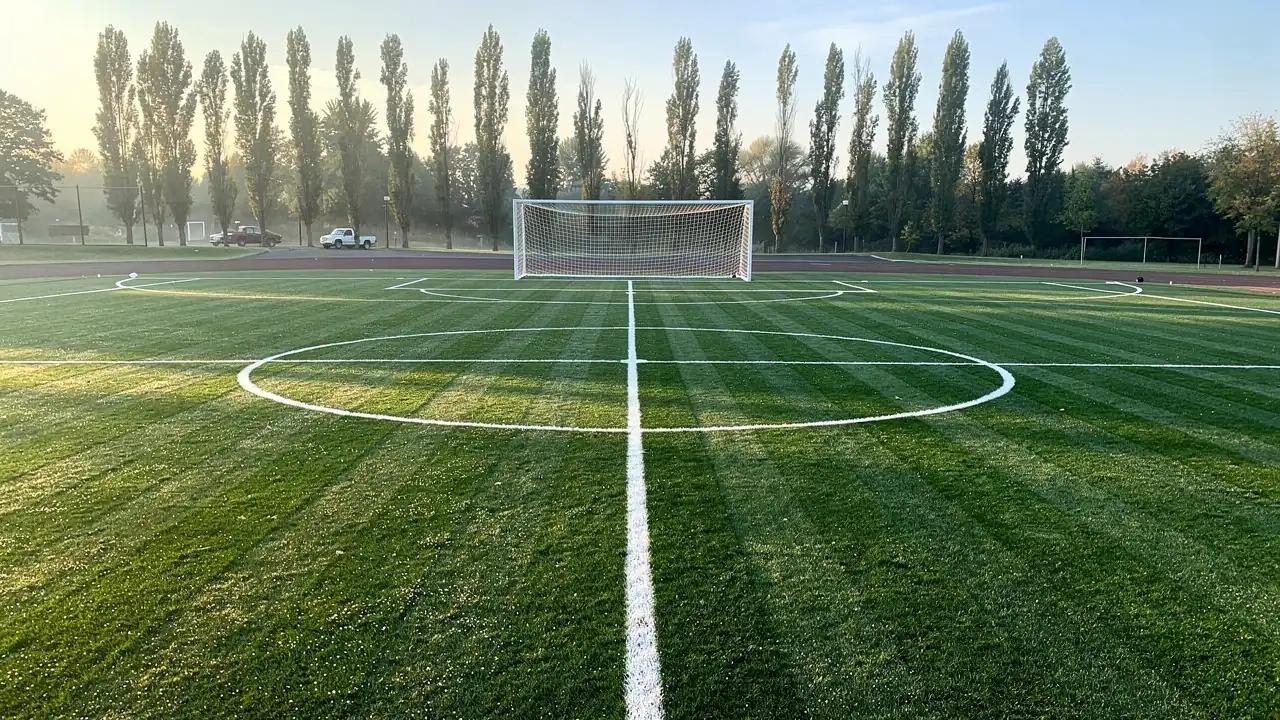
Soccer and football field lining
Kitchener Parking Lot Line Painting Pros lays out and maintains soccer and football field lines for youth soccer clubs, adult leagues, schools and municipalities across Kitchener-Waterloo. We mark natural grass through the season and put temporary lines on artificial turf for tournaments and extra fields.
Field lining is different from every other job we do. The surface grows, gets mowed every few days and soaks up rain, so a field needs a crisp first layout in spring and then repaints that keep pace with the grass.
We have been a dedicated line painting company in Waterloo Region since 2015. On fields we use water-based turf marking paint through a walk-behind field striper, measured to IFAB Laws of the Game and Football Canada field dimensions.
What we mark
We offer four kinds of field work, and most clubs book a combination for the season. Every field starts with a measured layout and then moves onto a repaint rhythm.
Full layouts in spring using string lines and squared corners, with goal and penalty areas, arcs and the centre circle measured fresh.
Repaints over the existing lines on a set day each week or every second week, timed ahead of game days.
Extra small-sided fields, crisp lines for showcase games and temporary layouts on turf, painted the day before the event.
Soccer and Canadian football on the same grass in two colours, so both sports read clearly.
Field sizes
Full-size soccer fields range from 90 to 120 m long and 45 to 90 m wide under the IFAB Laws of the Game, with 105 m by 68 m the common target. Youth fields are smaller and set by your club's or district's age-group chart, and Canadian football fields are 110 by 65 yards between the goal lines.
Youth sizes change with age and game format, and clubs in Ontario follow Ontario Soccer and Canada Soccer guidance through their district. Send us your club's chart and we mark every field to it.
Lines on any soccer field must all be the same width and no wider than 12 cm (4.7 in). We paint 10 cm lines on most fields.
A Canadian field is 110 yards between goal lines and 65 yards wide, with 20-yard end zones, so it is 150 yards long overall. The goal posts stand on the goal line, not at the back of the end zone as in American football.
Hash mark positions differ between the CFL and amateur Football Canada codes, so we confirm your league's spacing before marking them.
Shared fields carry soccer lines in white and football yard lines in a second colour such as yellow or blue. Where touchlines and sidelines nearly coincide, we offset them so neither looks doubled.
| Field | Length x width | Key markings |
|---|---|---|
| Soccer, full size | 90 to 120 m x 45 to 90 m; 105 m x 68 m common | Penalty area 16.5 m, goal area 5.5 m, penalty mark 11 m, centre circle and penalty arc 9.15 m radius, 1 m corner arcs |
| Soccer, 9v9 (about U11 to U12) | Roughly 70 to 80 m x 45 to 55 m | Scaled penalty and goal areas from your league's chart |
| Soccer, 7v7 (about U9 to U10) | Roughly 50 to 65 m x 35 to 45 m | Small penalty areas and centre circle, per league chart |
| Canadian football | 110 yd x 65 yd plus two 20 yd end zones (100.6 m x 59.4 m between goal lines) | Yard lines every 5 yd, 55-yard centre line, goal lines, hash marks to your league's code |
| American football, for comparison | 100 yd x 53 1/3 yd plus two 10 yd end zones | Rarely needed here; Canadian fields are longer and wider |
Grass or turf
Natural grass needs regular repaints because the painted blades grow and get mowed off. Artificial turf usually has permanent lines tufted in when it is built, and we add temporary lines on top for extra fields and events.
Paint sits on the grass blades, not the soil. Every mow takes some colour away, so grass fields need a repaint every one to three weeks in season.
Permanent turf lines are sewn in by the turf installer. We paint temporary lines with removable turf paint, which lifts off with the maker's remover and a turf brush when the event is over.
Paint
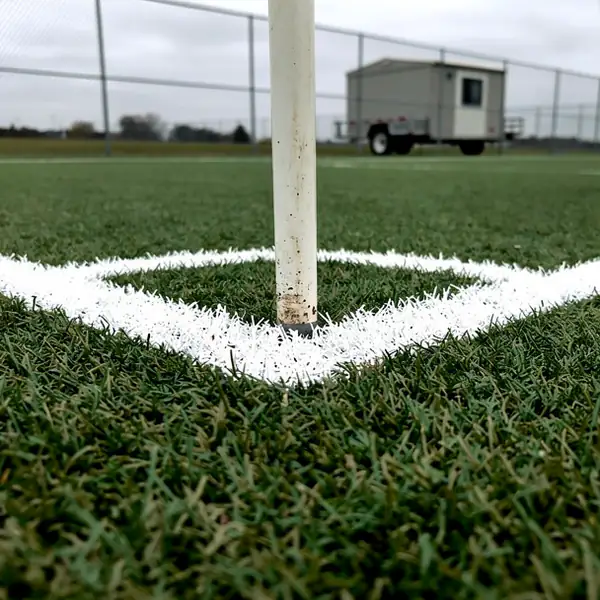
Turf-safe field paint is a water-based marking paint made to coat grass blades without harming the plant. Used at the right dilution it leaves a bright line and healthy grass underneath; used too rich it can stress the turf in summer heat.
| Surface | Paint we use | How often | Removal |
|---|---|---|---|
| Natural grass, spring growth | Water-based turf marking paint, diluted to the label ratio | Every 1 to 2 weeks | Mows out on its own |
| Natural grass, mid-summer | Same paint, slightly richer mix if growth is slow and lines must last | Every 2 to 3 weeks | Mows out on its own |
| Artificial turf, temporary lines | Removable turf paint made for synthetic fibres | Per event | Maker's remover and a turf brush |
| Artificial turf, permanent lines | Tufted in by the turf installer | Not painted | Not applicable |
Field paint is a different product from the waterborne traffic paint we use on parking lots, but both are water-based. Our guide to paint types and VOC rules covers how the products differ.
Our process
A first layout takes five steps, and repaints simply follow the existing lines with the striper. A full-size soccer layout usually takes a few hours; a repaint takes far less.
We locate last season's corners, goal sockets or site plan points, so the field lands where the goals and irrigation expect it.
String lines mark the touchlines and goal lines, and we check both diagonals. On a 105 m by 68 m field each diagonal is about 125.1 m.
A tape and centre pin swing the 9.15 m centre circle, the penalty arcs and the 1 m corner arcs, and the penalty and centre marks are spotted.
We follow the strings with a walk-behind field striper that sprays an even 10 cm line at a steady walking pace.
Return visits trace the faded line without new strings, which keeps the field in the same place all season and saves time.
Pricing
Soccer field relining costs $250 to $450 per field per visit before HST, paint only. The first layout of the season costs more than a repaint, because measuring and squaring take longer than tracing existing lines.
The full rate card is in our line painting price guide.
Why us
Leagues and schools book us because lines are painted on the day promised, ahead of every game. A league schedule only works if the lines are there on Saturday morning.
A fixed repaint day each week, moved around rain, so fields are fresh for the weekend.
Fields in Waterloo, Cambridge and Guelph sit within 35 minutes of our Kitchener shop.
Schools often add playground games and a basketball court to the same visit.
Every job is backed by WSIB coverage, liability insurance and a 1-year labour warranty on our application. See every court and field we paint on our sports court line painting overview.
FAQ
Club volunteers, athletic directors and parks staff ask these questions most.
No. Turf-safe field marking paint coats the grass blades without harming the plant when it is mixed at the maker's ratio. Problems come from over-rich mixes or products not made for grass.
Every one to two weeks in spring growth and every two to three weeks in mid-summer. Mowing frequency and rain make the biggest difference.
Yes, for temporary lines, using removable turf paint made for synthetic fibres. Permanent turf lines are tufted in by the turf installer.
Yes. We mark the 110 by 65 yard field with 20-yard end zones, yard lines every 5 yards and hash marks to your league's code.
Free quote
Clubs that start in May should book their first layouts in April, with weekly repaints set for the season. Send the number of fields, their sizes and your game schedule, and we will quote per visit within one business day.