Paint and materials guide
Parking Lot Line Paint in Ontario: Types and Canada's VOC Rules
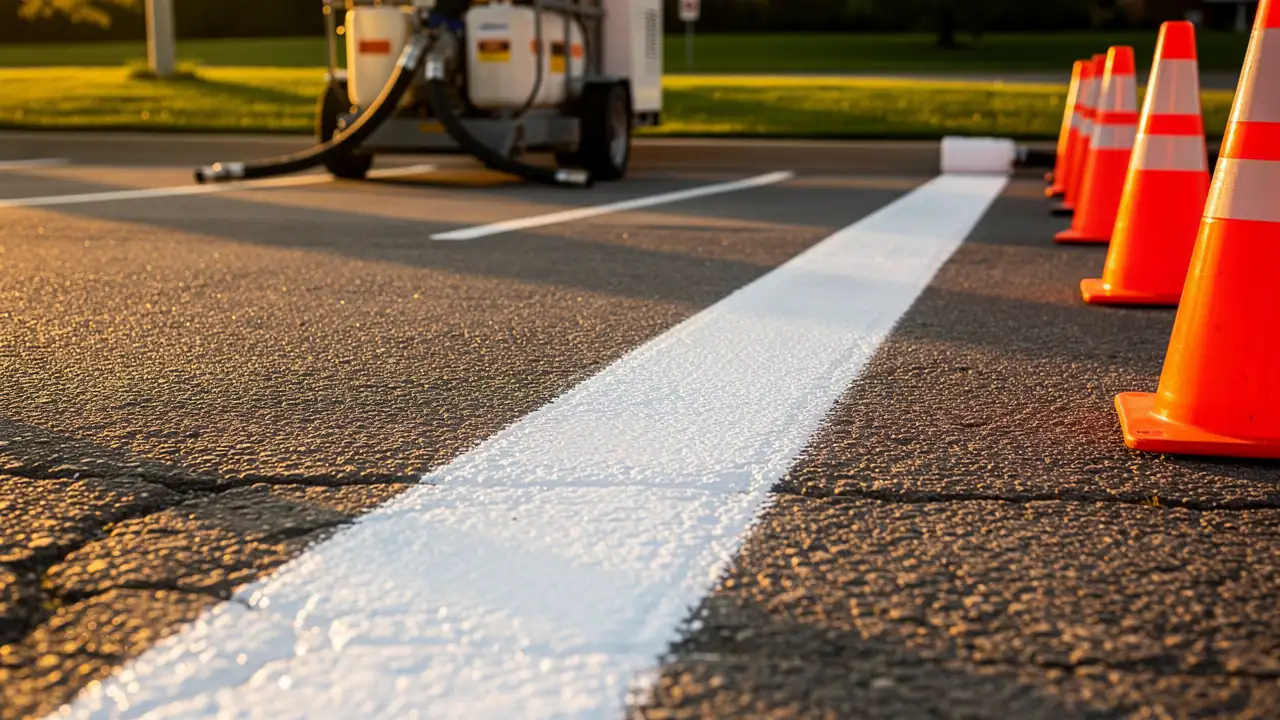
Kitchener Parking Lot Line Painting Pros has chosen and sprayed traffic paint for parking lots, garages, courts and warehouse floors across Waterloo Region since 2015, on more than 550 jobs. The paint you pick, and how thick it goes on, decides how long your lines last more than any other factor.
In Canada the choice is not only about durability. Federal limits on volatile organic compounds (VOCs) decide which traffic paint can legally go down on which date, and they are the reason your summer restripe uses water-based paint.
This guide compares waterborne, solvent-based, thermoplastic, MMA and epoxy markings for property managers and facility teams in Ontario, and explains the rules behind each. Every regulatory figure links to its federal source.
Short answer
Which Paint Is Best for Parking Lot Lines?
Waterborne acrylic traffic paint is the best choice for most Ontario parking lot restripes, and from May 1 to October 15 it is effectively the only legal one for outdoor lines. Solvent-based paint suits early spring and late fall work, thermoplastic suits the spots that wear out every year, and epoxy suits indoor floors.
The right answer depends on the surface, the season and the traffic. Here is how we choose.
- Summer restripe of an asphalt lot: waterborne acrylic traffic paint, sprayed at 15 mils wet.
- April or late October restripe on cool asphalt: solvent-based alkyd or chlorinated rubber traffic paint, legal outside the May 1 to October 15 window.
- Crosswalks, stop bars, arrows and drive-thru lanes: preformed thermoplastic, which lasts 3 to 6 years.
- Underground garages and warehouse floors: two-part epoxy or polyurea line coatings.
- Light-duty indoor areas: waterborne acrylic floor marking paint.
- Asphalt basketball and playground surfaces: waterborne acrylic, with 100% acrylic court paint on acrylic-surfaced tennis and pickleball courts.
Federal rules
Canada's VOC Limits for Traffic Marking Paint
Traffic marking paint sold or used in Canada may contain no more than 450 g/L of VOCs, and from May 1 to October 15 no one may apply traffic marking paint above 150 g/L. Environment and Climate Change Canada states plainly that there are no exceptions to the seasonal restriction.
The limits come from the Volatile Organic Compound Concentration Limits for Architectural Coatings Regulations (SOR/2009-264), summarised in the federal traffic marking coating factsheet. They cover coatings used to mark streets, highways, curbs, driveways, parking lots, sidewalks and airport runways.
| Period | Maximum VOC content | What it means on your lot |
|---|---|---|
| May 1 to October 15 | 150 g/L (seasonal use limit, section 4) | Waterborne acrylic traffic paint for outdoor lines |
| October 16 to April 30 | 450 g/L (schedule item 50) | Solvent-based alkyd and chlorinated rubber paints also allowed |
| Any time, product label | Products above 150 g/L must be labelled as not for application from May 1 to October 15, with a manufacture date or code | Check the can or lid if a contractor brings solvent paint in summer |
The seasonal limit is a rule on use, not just sale. A contractor who sprays solvent traffic paint on your lot in July is breaking it, and so is an owner who does it themselves.
If a summer quote mentions oil-based or solvent paint, ask for the product data sheet and check the VOC content. Ozone and smog are worst in summer, which is why the rule bites from May to mid-October.
Paint types
Traffic Paint Types Compared
There are five marking materials you will see quoted for Ontario parking lots and floors, and they differ in life, cure time and cost more than most owners expect. The table gives the quick comparison, and each type is explained below it.
Waterborne Acrylic: The Summer Standard
Waterborne acrylic traffic paint uses water as its main carrier, which keeps it under the 150 g/L summer limit. It is dry to the touch in 10 to 15 minutes on a warm day and drivable in 30 to 60 minutes.
The trade-off is durability. It is softer than solvent paint, needs air and pavement at 10°C and rising to cure, and depends heavily on film thickness and a clean surface.
Solvent-Based Alkyd: Spring and Fall Paint
Solvent-based alkyd and chlorinated rubber paints carry more VOCs, up to the 450 g/L cap, and bite better into cool asphalt in early spring and late fall. They are legal only from October 16 to April 30.
That window suits an April restripe ahead of the rush, or striping after a late-season paving job. On cold mornings they cure more reliably than waterborne paint.
Thermoplastic Markings
Preformed thermoplastic comes as flat sheets and shapes that are laid on the pavement and fused in place with a propane torch. It is many times thicker than paint, lasts 3 to 6 years, and opens to traffic as soon as it cools.
A painted ladder crosswalk costs $250 to $600, and the thermoplastic version $900 to $2,000. Where paint would need redoing every spring, thermoplastic can pay for itself within its life.
Methyl Methacrylate (MMA)
MMA is a two-part cold plastic that hardens by chemical reaction rather than evaporation, giving a very hard, long-lasting marking. It is mostly specified on municipal roads, bike lanes and high-traffic crossings.
It needs specialist mixing equipment and careful prep, so it is rarely cost-effective on a private lot. It is not part of our standard materials; for durable private-lot markings we recommend thermoplastic instead.
Epoxy for Indoor Floors and Garages
Two-part epoxy and polyurea line coatings bond hard to concrete and stand up to forklift and tire traffic indoors for 3 to 5 years. Indoor work can go ahead year-round as long as the slab is above 10°C and dry.
Garage and warehouse work follows the ventilation rules in Ontario Regulation 851 for industrial establishments. Our warehouse floor line painting and parking garage line painting pages explain how we phase indoor jobs.
| Type | Typical life | Dry or traffic time | Relative cost | Best use |
|---|---|---|---|---|
| Waterborne acrylic | 12 to 24 months outdoors | Dry to touch 10 to 15 min; drivable 30 to 60 min, up to 2 hours when cool or humid | Lowest | Summer restripes, stall lines, arrows, stencils |
| Solvent-based alkyd or chlorinated rubber | Similar to waterborne on a plowed lot | Varies by product and temperature; follow the data sheet | Low | Cool-weather work from October 16 to April 30 |
| Preformed thermoplastic | 3 to 6 years | Open to traffic once it cools | Highest per marking | Crosswalks, stop bars, arrows, drive-thru lanes |
| Methyl methacrylate (MMA) | Multi-year | Cures by chemical reaction | High, specialist crews | Municipal roads, bike lanes, busy crossings |
| Epoxy or polyurea | 3 to 5 years indoors under forklift traffic | Longer cure than paint; product dependent | Mid to high | Parking garages and warehouse floors |
Reflective paint
Glass Beads and Night Visibility
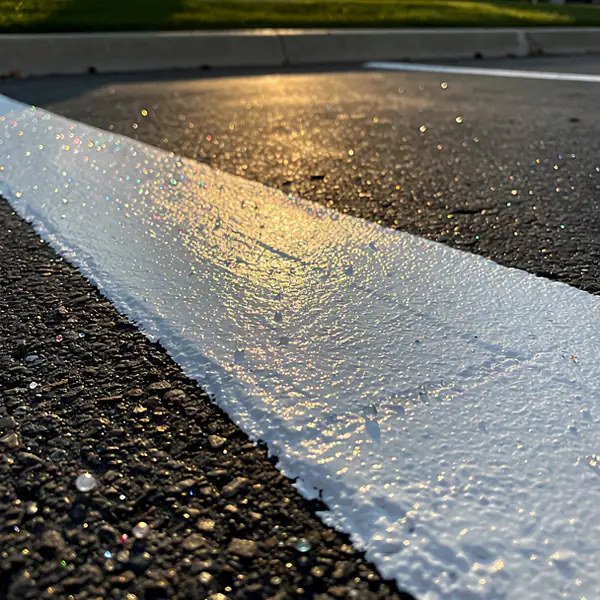
Glass beads make painted lines retroreflective: headlight beams enter each bead, bounce off the back and return toward the driver, so the line glows at night. We drop Type 1 glass beads into wet paint on request, so they lock into the film as it dries.
Ontario's provincial pavement marking specification, OPSS.PROV 710, is the construction standard municipal and provincial road markings follow. Private parking lots are not bound by it, so reflective road paint on a lot is your choice.
Beads are worth it at entrances, fire routes, dim back rows and any lot used heavily after dark, such as hotels, hospitals and late-night retail. They add little in a well-lit plaza that closes in the early evening.
Beads also make a slightly worn line easier to read in rain, when unbeaded paint almost disappears under headlights.
Film thickness
Wet Film Thickness: Why Mils Matter
Wet film thickness is how thick the paint is the moment it leaves the spray tip, measured in mils, or thousandths of an inch. We spray waterborne traffic paint at 15 mils wet, which dries to about 7 to 8 mils.
Thin film is the most common reason a cheap restripe fades by mid-summer. At 15 mils a US gallon covers about 300 to 330 linear feet of 4 in line, so a contractor stretching a gallon much further is spraying thinner.
- Ask what wet film thickness the crew sprays, and what the product data sheet recommends
- Ask how much paint the job will use: a lot with 5,000 linear feet of 4 in line needs roughly 15 to 17 US gallons at 15 mils
- A wet film gauge pressed into fresh paint reads the thickness on the spot
- Compare quotes on paint volume and film thickness, not just on stall price
Thicker is not always better. Paint laid far heavier than the data sheet allows dries slowly, stays soft and can track onto tires, so we work within the manufacturer's range.
DIY or hire
Can Anyone Paint Parking Lot Lines?
Yes, no licence is needed to paint lines on private property in Ontario, but the lines still have to meet your zoning by-law, the AODA rules for accessible stalls and the federal VOC limits. Most DIY jobs fail on durability or layout rather than legality.
Aerosol cans and retail paints go on thin and wear off within months, and many are layout marking paints rather than traffic marking coatings. Freehand layouts drift, stalls end up narrower than Kitchener's 2.6 m minimum, and accessible aisles come out too narrow.
- Hire a pro when you are changing the layout or adding stalls, because zoning and AODA rules then apply
- Hire a pro when the lot has accessible stalls, fire routes or EV stalls that must match signs and by-laws
- Hire a pro when more than a handful of lines need doing; at $9 to $15 per stall, it is usually cheaper than buying the equipment
- Hire a pro when you need lines that last a full year, not a few months
For one or two faded arrows, a careful touch-up with proper traffic paint can bridge a season. For anything more, our parking lot line painting crews finish most small plazas in one evening, and our guide to parking stall dimensions covers the sizes to paint to.
Paint advice
Ask Us Which Paint Fits Your Lot
Tell us your surface, your traffic and when you want the work done, and we will recommend the paint and quote it in writing within one business day. If thermoplastic or epoxy makes more sense for part of the job, the quote will show both options side by side.
Prices for paint, thermoplastic and floor coatings are on our line painting price guide.
- Paint matched to the season and the federal VOC window
- 15 mil wet film on every waterborne line
- Thermoplastic quoted where paint would need yearly repainting
- Shop
- 85 West Ave, Kitchener, ON N2M 3A2
- Monday to Saturday
- 7:00am to 9:30pm
- Sunday
- 9:00am to 9:00pm