New Court Layouts
Full lines on freshly paved asphalt or a new concrete pad. New asphalt needs about 30 days for its oils to cure before final lines go down.
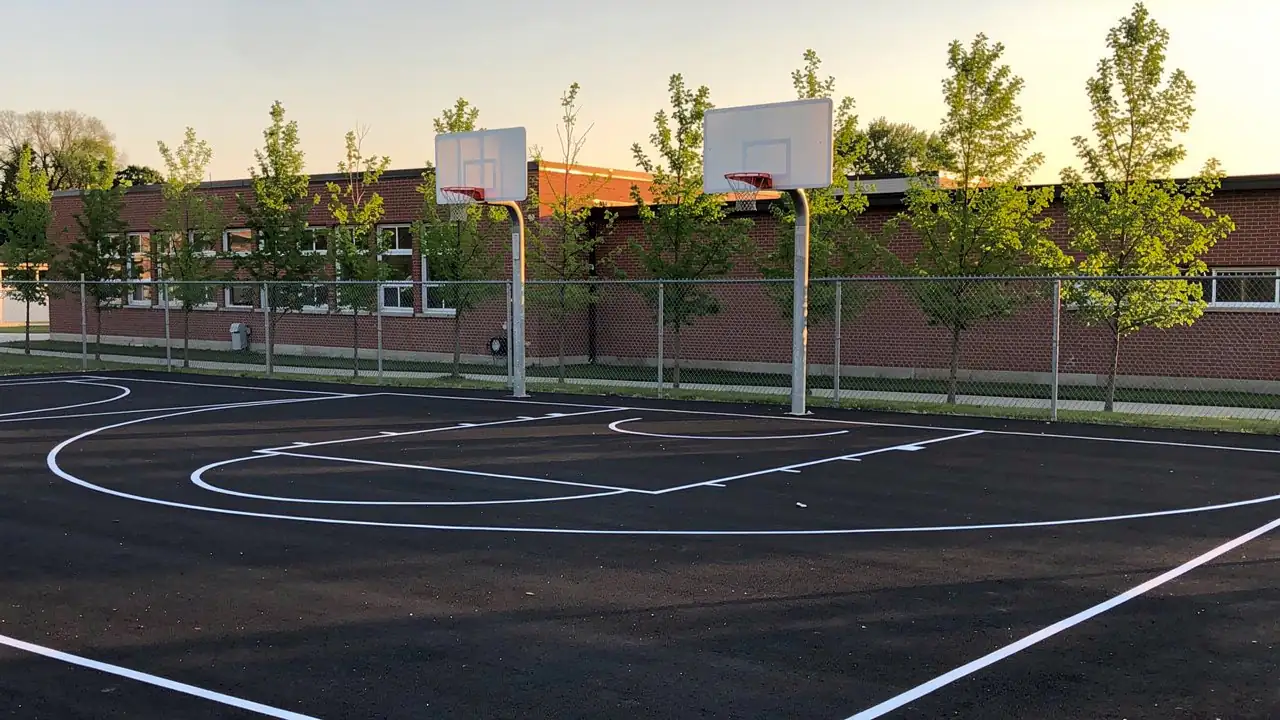
Full courts, half courts, driveways
Kitchener Parking Lot Line Painting Pros paints basketball courts for school yards, municipal parks, condo amenity areas and family driveways across Kitchener-Waterloo. We lay out full courts, half courts and single-key driveway courts to FIBA, NBA or high school dimensions, or to a custom size that fits your slab.
Since 2015 our crews have finished more than 550 line painting jobs, and a basketball key is one of the most common add-ons when a school yard gets its summer markings. What separates a good court from a fuzzy one is the edge, so we tape every line and seal the tape before the colour goes on.
We paint on bare asphalt, concrete pads and acrylic-surfaced courts. The paint is chosen for the surface: waterborne acrylic on asphalt, primed acrylic on concrete and 100% acrylic court line paint on coated courts.
What we paint
We paint four kinds of basketball jobs, from a first layout on new pavement to a single key on a family driveway. Each starts with measuring from the hoop, not from the old lines.
Full lines on freshly paved asphalt or a new concrete pad. New asphalt needs about 30 days for its oils to cure before final lines go down.
We check the old layout against FIBA or your chosen size first. If the arc or key was painted wrong, we correct it rather than repaint the mistake.
A key, free-throw line and arc on the yard, often painted with playground games and school yard markings in the same July visit.
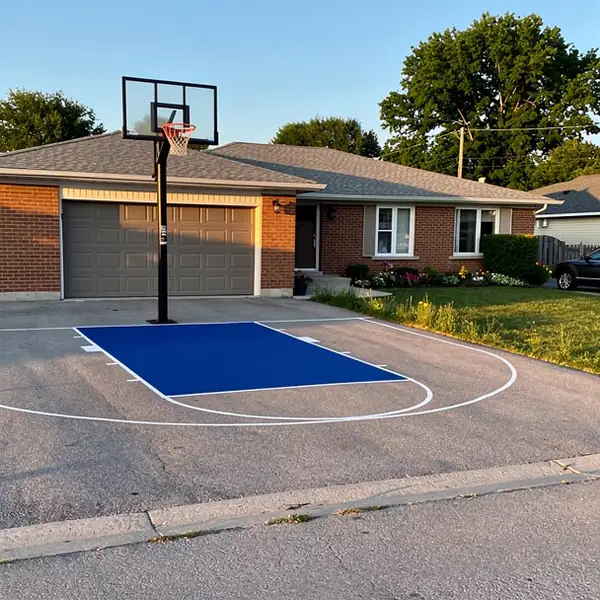
A key and shortened arc sized to the driveway, with the hoop post placement checked before we paint so the free-throw line ends up where it belongs.
Indoor hardwood gym lines are planned with your floor refinisher, the same way we handle badminton court lines on gym floors.
Common problems
Basketball lines fail in four predictable ways, and each one tells us something about how the court was painted. Spotting the cause decides whether a simple repaint will last.
The free-throw line and the top of the key wear first because every possession crosses them. Wear there alone means a normal repaint is due.
Paint that peels in sheets usually went onto dusty, damp or freshly paved asphalt. We sweep, blow off and dry-check the surface so the new coat bonds.
An arc drawn freehand wanders by 10 to 30 cm from one side to the other. We swing every arc from a fixed centre point under the rim so both sides match.
Fuzzy edges where a white line meets a coloured key mean the tape was never sealed. Paint wicked under it through the surface texture.
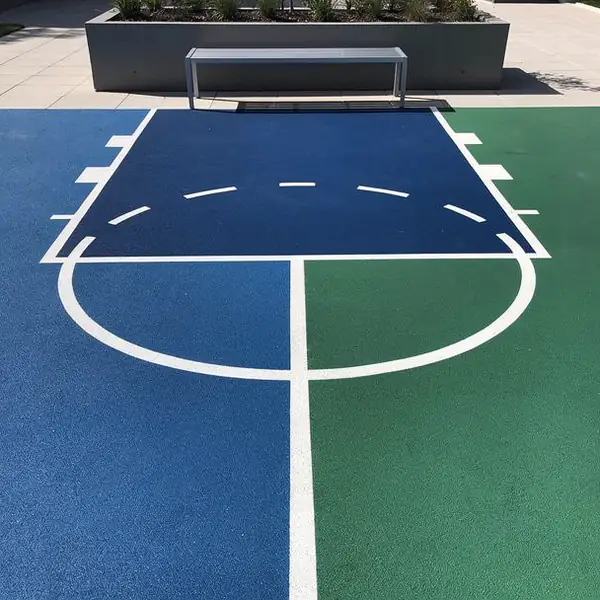
Court sizes
A regulation FIBA court is 28 m by 15 m with a 6.75 m three-point arc, and that is the size we recommend for any public or school court. NBA and high school courts use imperial sizes, and driveways get scaled versions that fit the space.
Canada Basketball plays FIBA rules, so school and club players in Ontario train on FIBA markings. Painting a public court to FIBA means the arc and key match what kids see in league games.
If your league plays a different code, tell us before we lay out. Changing an arc later means grinding or painting over the old one.
Under FIBA, the basket centre sits 1.575 m (5 ft 2 in) in from the end line, so a full 6.75 m arc needs at least 8.3 m of depth plus room to land. Most driveways are shorter, so we scale the arc down and keep the 12 ft key.
Set the hoop post before we paint. We measure from the plumb point under the rim, and moving the post afterwards throws every line off.
| Court type | Playing area | Three-point distance | Key width |
|---|---|---|---|
| FIBA full court | 28 m x 15 m (91 ft 10 in x 49 ft 3 in) | 6.75 m (22 ft 2 in); 6.60 m (21 ft 8 in) in the corners | 4.90 m (16 ft 1 in) |
| NBA | 94 ft x 50 ft (28.65 m x 15.24 m) | 23 ft 9 in (7.24 m); 22 ft (6.71 m) in the corners | 16 ft (4.88 m) |
| High school (NFHS) | 84 ft x 50 ft (25.6 m x 15.24 m) | 19 ft 9 in (6.02 m) | 12 ft (3.66 m) |
| School yard or park court | Sized to the pad, often 20 m to 26 m long | 6.75 m FIBA arc where the pad allows | 4.90 m FIBA key |
| Half court | 14 m x 15 m (FIBA half) or what the yard allows | 6.75 m, or a shorter youth arc | 4.90 m or 12 ft |
| Driveway court | Commonly 6 m x 6 m to 9 m x 10 m | Shortened arc, usually 5 m to 6 m | 12 ft (3.66 m) fits most driveways |
Surfaces
Bare asphalt, acrylic-surfaced courts and concrete pads each need a different paint and prep. The table shows what we use on each and how long lines usually hold up.
| Surface | Paint we use | Prep | Expected life |
|---|---|---|---|
| Bare asphalt (school yards, driveways) | Waterborne acrylic court or traffic marking paint | Sweep and blow off, treat oil spots, wait about 30 days on new asphalt | Usually 2 to 3 seasons with foot traffic; less where a school yard is plowed |
| Acrylic-surfaced court | 100% acrylic textured line paint matched to the surfacing system, such as Laykold or Plexipave | Wash the court, tape and seal edges with line primer or base colour | Usually lasts until the court is next resurfaced |
| Concrete pad | Acrylic line paint over a concrete primer | Etch or grind for profile; new concrete cures about 28 days | Usually 2 to 3 seasons once properly primed |
Summer exterior paint must meet Canada's 150 g/L VOC limit from May 1 to October 15, which is why we use waterborne products in season. Our guide to traffic paint types and VOC rules explains the difference.
Our process
A crisp court takes six steps, and most of the time goes into measuring and taping, not spraying. A full outdoor court is usually painted in one day, weather permitting.
We drop a plumb line from the centre of each rim to the surface. Every key, arc and free-throw line is measured from that point.
Chalk lines mark the sidelines and end lines, and we check both diagonals match so the court is square, not a parallelogram.
A trammel or fixed radius string sets the 6.75 m arc, the 1.80 m circles and the 1.25 m no-charge semicircle in one true curve.
We tape both sides of every line, then brush clear primer or the base colour over the tape edge. That seal fills the surface texture so line paint cannot bleed under.
Lines get two coats for full opacity. One heavy coat sags into the texture and dries with a soft edge.
Tape comes off while the last coat is still wet, so the edge breaks clean. We check widths, then send before and after photos the same day.
Custom work
We paint solid colour keys, three-point area fills and centre-court logos on top of the line work. Fills go down first, and lines are taped and painted over them so every edge stays sharp.
Logo and lettering stencils are made through our custom stencil and marking service, the same shop work we do for parking lots.
Pricing
Full court lines cost $650 to $1,200 before HST, and smaller jobs such as a driveway key fall under our $450 minimum charge. Colour fills and logos are priced on top of the lines.
Our line painting price guide lists the full rate card. We serve school boards and homeowners from Kitchener out to Waterloo and Cambridge, both within a 25-minute drive of our shop.
FAQ
These are the questions school staff and homeowners ask most before booking a court.
Yes. A driveway at least 6 m by 6 m fits a 12 ft key and a shortened arc, and the surface needs to be sound, clean and dry. New asphalt should cure about 30 days first.
On bare asphalt with foot traffic only, lines usually last 2 to 3 seasons. School yards that are plowed in winter wear faster, and lines on acrylic court surfacing usually last until the court is resurfaced.
No, we paint lines only. Have your hoop installer set the post first, and we measure every line from the rim once it is in place.
Waterborne lines are dry to the touch in 10 to 15 minutes on a warm day. We ask for the court to stay off-limits until the next day so the paint cures fully under shoes.
Free quote
Send us a photo of the court or driveway, the rough measurements and where the hoop stands. We reply with a written price for lines, fills and logos, usually within one business day.